
After work on the diesel particulate filter (DPF), the measured soot value must be relearned in CarPort so that the engine control unit calculates with the real state of the filter or sensor again.
This guide is used in the following scenarios:
- Particulate filter (DPF) replaced – the new filter is practically soot-free; the measured soot value must be re-referenced.
- Particulate filter (DPF) cleaned – after cleaning, the filter is (almost) soot-free; the old, high soot value no longer fits.
- DPF differential pressure sensor replaced – the new sensor deviates minimally from the old one at its zero point; the measured soot value is re-referenced to the new sensor.
In all three cases the procedure is identical: run the block “New adaptation of measured soot value” in Basic Settings.
The differential pressure sensor on the diesel particulate filter (DPF) measures the pressure difference upstream and downstream of the filter. The more soot is stored, the higher the flow resistance and the greater the differential pressure. From this value the engine control unit derives the measured soot value and continuously compares it with the calculated model value (from load, engine speed, air mass, exhaust gas temperature and fuel consumption).
1. Why relearn?
- The differential pressure sensor provides the reference variable for the soot load. The control unit compares the measured soot value (from the differential pressure) with the calculated model value.
- After a filter replacement or a filter cleaning, the filter is actually (almost) soot-free – the stored, high soot value no longer fits and must be re-referenced to a low starting value.
- After a sensor replacement, the new sensor deviates minimally from the old one at its zero point; relearning re-references the measured soot value to the new sensor.
- Without relearning you risk more frequent regenerations with increased fuel consumption and oil dilution or – in the opposite case – an overloaded DPF with power loss and an illuminated engine warning light.
⚠️ Do not confuse: Block
1076“Low-pressure EGR differential pressure sensor adaptation” applies to a different sensor (low-pressure EGR path) and is not the correct block for the DPF differential pressure sensor.
2. Prerequisites
- The diagnostic interface is connected (the status bar at the bottom shows e.g. “Connected with K+CAN. Adapter ready.”)
- The performed work is complete: a new or cleaned filter installed or a new sensor fitted; the pressure hoses and connector are seated correctly and sealed
- Ignition on, engine off – without an exhaust flow there is no differential pressure at the sensor, so the zero point is captured correctly
- Stable vehicle electrical system voltage (connect a battery charger if needed)
- Erase the engine control unit’s fault memory beforehand
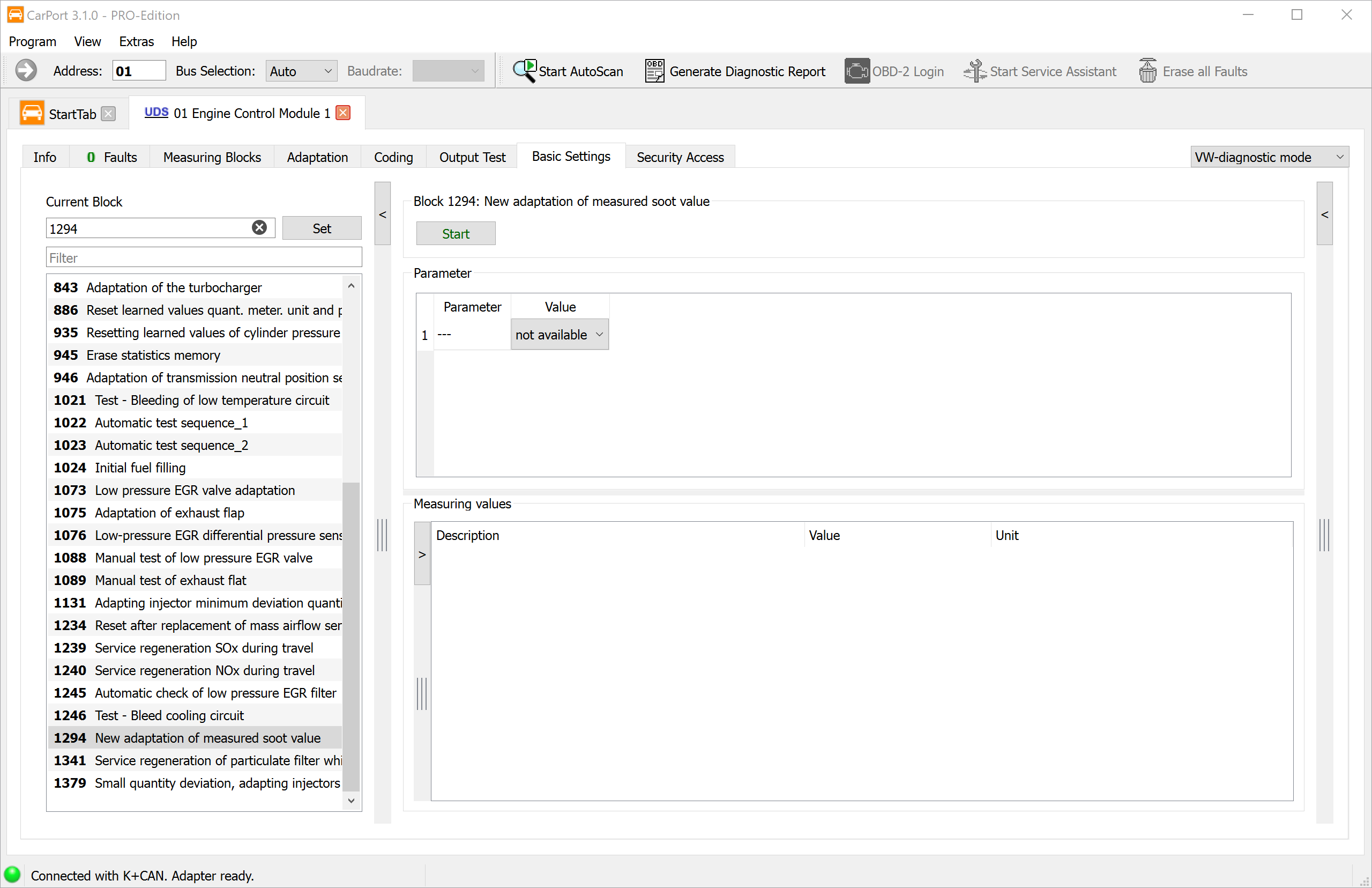
3. Open Basic Settings and select the block
- Select the control unit 01 Engine Control Module 1.
- Switch to the Basic Settings tab.
- Select the entry “New adaptation of measured soot value”.
Note: Depending on the engine and software level, the block numbering may differ slightly. The decisive block is “New adaptation of measured soot value”.
4. Start the relearning
- Click Start at the top right.
- The control unit runs the relearning. In the Measuring values panel you can follow the progress – wait until the status reports completed or successful.
- Then switch the ignition off and wait at least 10 seconds so that the control unit reliably stores the values.
💡 If the required conditions are not met (e.g. engine running, voltage too low), the control unit aborts the basic setting. Establish the conditions from step 2 and start again.
5. Check the result
- Erase the fault memory and read it out again – there must be no new differential pressure or DPF fault stored.
- In the Measuring Blocks check the measured and the calculated soot mass for plausibility. With the engine stopped, the differential pressure should be close to 0.
- Take a short test drive – ideally with diagnostics connected – and verify that the pressure values are plausible across various load points and that no fault recurs.
6. Background: measured vs. modelled soot value
The control unit knows the DPF load via two independent paths:
- Measured soot value: calculated from the differential pressure (differential pressure sensor G505) and the exhaust gas volume flow. This exact value depends directly on the sensor and is relearned with Block 1294.
- Modelled soot value: determined arithmetically from operating data (engine speed, load, injection quantity, temperature) – independent of the sensor.
If the two values deviate too far from each other, the control unit reports a fault. The relearning ensures that the measured value once again matches the real state of the filter and sensor.
7. Notes
- Check hoses and connectors: A common cause of faults is not the sensor itself but sooted, kinked or leaking pressure hoses or a corroded connector. Check them as well during the replacement.
- Regeneration – when is it useful? A mere sensor replacement does not change the actual soot load; a service/emergency regeneration only makes sense if the filter is genuinely loaded. After a filter replacement or cleaning, however, the filter is actually (almost) empty – here it is only about re-referencing the measured soot value, not a regeneration.
- Correct sensor: The DPF differential pressure sensor is not the low-pressure EGR
differential pressure sensor (Block
1076) and not the exhaust gas pressure sensor – pay attention to the correct part number. - Conditions come from the control unit: Which values are displayed and which prerequisites apply is dictated by the control unit; if the conditions are not met, the routine will not run.
- Fault recurs? Check the pressure hoses (cracks, blockage, swapped connections), the plug connection and the wiring, as well as the correct seating of the sensor.
- Missing blocks: Depending on the engine, software level and coding, not all blocks are visible or they are named slightly differently – this is normal and not a fault.