
After cleaning or replacing the throttle body, the engine control module has to relearn the valve’s positions. On MQB vehicles, you trigger this throttle valve adaptation in CarPort via the Basic Settings of the engine electronics – the actual process only takes a few seconds.
1. When is the adaptation necessary?
On modern engines, the throttle body is adjusted electrically (E-Gas). To do this, the engine control module stores learned values, such as the lower mechanical stop and the limp-home position of the valve. These learned values no longer match when:
- the throttle body has been cleaned, removed and refitted, or replaced,
- the throttle body unit was disconnected (e.g. during work on the intake tract),
- the engine control module was replaced or disconnected,
- the battery was disconnected or deeply discharged,
- the accelerator pedal module was removed or installed.
Typical symptoms of missing or incorrect learned values:
- rough, “hunting” or excessively high idle
- poor or delayed throttle response
- EPC light and limp-home mode
- fault codes for the throttle body control, e.g. P0638 (throttle actuator control range/performance) or P2101 (throttle actuator motor)
MQB engine control modules adapt the throttle body automatically to a certain extent, e.g. shortly after switching on the ignition. After cleaning or replacement, however, you should still trigger the adaptation deliberately and check the result, rather than relying on the automatic adjustment.
2. On which engines is the adaptation relevant?
Petrol engines (TSI/MPI): This is where throttle body adaptation really matters. On the MQB petrol engines – the EA211 series (1.0/1.2/1.4/1.5 TSI) as well as the EA888 (1.8/2.0 TSI, e.g. Golf GTI/R, Audi S3) – the throttle valve is the central actuator for load control. If the learned stops are incorrect, the idle in particular suffers, and the control module may go into limp-home mode.
Diesel engines (TDI): The MQB diesels of the EA288 series (1.6/2.0 TDI) also have a throttle body (control flap). However, it is not used for load control, but for exhaust gas recirculation, particulate filter regeneration and shutting the engine down smoothly. This flap learns by itself – often audible as a brief whirring sound after switch-off. Manual relearning is usually not necessary on the diesel; depending on the engine, the Basic Setting for it does not even exist.
Note for those familiar with older models: The classic procedure via measuring block 060 or 098 (“ADP running”) no longer exists on MQB vehicles. It has been replaced by the Basic Setting “Checking throttle valve adaptation”, which triggers the adaptation and reports back the result.
3. Prerequisites
All conditions must be met at the same time, otherwise the Basic Setting will not start or will abort:
- Diagnostic interface is connected (the status bar at the bottom shows e.g. “Connected with K+CAN. Adapter ready.”)
- Ignition on, engine off
- Foot off the accelerator – do not touch it during the entire procedure
- No fault codes in the engine control module (first fix the cause, clear the faults, then switch the ignition off and on again)
- Vehicle voltage at least approx. 11.5 V (connect a battery charger if the battery is weak)
- Coolant temperature between approx. 5 and 95 °C (not directly after a drive and not in severe frost)
- The throttle body is clean or repaired
4. Performing the adaptation with CarPort
- Open the control module 01 Engine Control Module 1 (e.g. via the Address field at the top left).
- Switch to the “Basic Settings” tab.
- In the block list on the left, find the block “Checking throttle valve adaptation” – the quickest way is to type throttle in the Filter field. In the example, it is Block 814; the number may vary depending on the engine.
- Select the block and click “Start”.
- Wait until the Basic Setting is reported as completed. During this time, do not operate anything on the vehicle – especially not the accelerator.
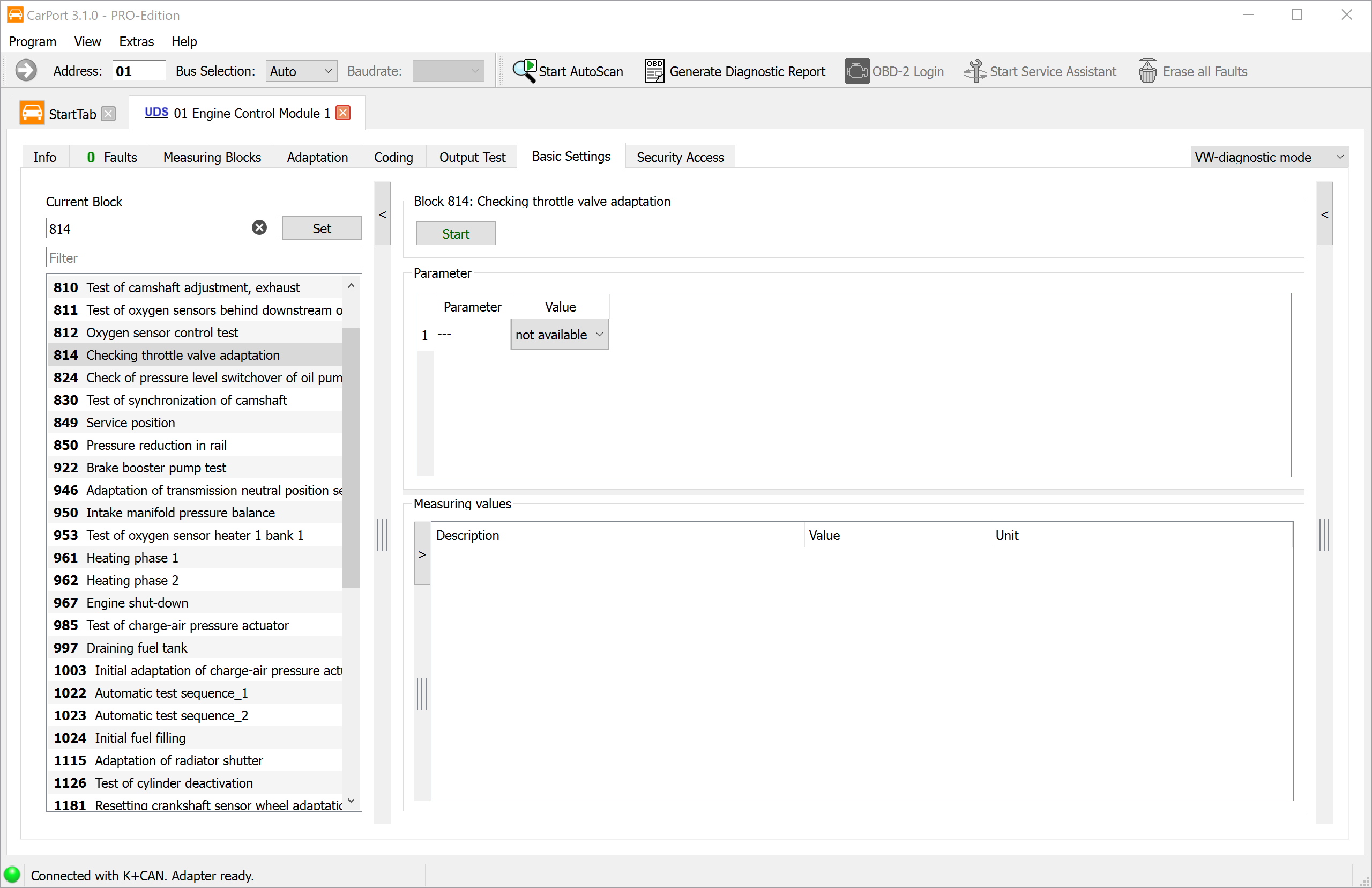
The fact that Parameter shows “not available” is normal – this Basic Setting does not require any input values.
- Then switch off the ignition and wait about 30 seconds so that the control module stores the learned values permanently.
5. Checking the result
- Switch the ignition back on and read out the fault memory of the engine electronics – no new faults for the throttle body control may be stored.
- Start the engine and check the idle: it should be stable and the engine speed at the usual level.
- If the Basic Setting aborts or reports an error, check the prerequisites from Step 3 (fault memory, voltage, temperature) and repeat the adaptation.
6. Pitfalls and notes
- Fault memory first: With stored faults in the engine electronics, the adaptation does not run reliably. First fix the cause, clear the faults, switch the ignition off/on – then adapt.
- Don’t “adapt over” a coked-up valve: If the throttle body is heavily contaminated, the control module learns incorrect stops. Clean it first, then relearn.
- Be careful when cleaning: Do not use aggressive solvents such as pure acetone – they attack the valve’s coating, causing it to get dirty again more quickly. Use a special throttle body cleaner and a soft cloth or a soft brush.
- Rough idle right after cleaning: A slightly elevated engine speed or a somewhat sluggish idle are normal at first. The control module refines the learned values by itself over the next few drives.
- Weak battery: If the voltage drops during the adaptation, it will be aborted or incorrect values will be learned. When in doubt, connect a battery charger.
- Differing block number: The number of the Basic Setting differs depending on the engine and control module software. When in doubt, search via the Filter field for throttle.
- Diesel: If you cannot find a matching Basic Setting on a TDI, this is not a fault – the control flap there learns by itself (see Step 2).