
Exhaust gas recirculation (EGR) feeds part of the exhaust gas back into the intake tract. The cooled, oxygen-poor exhaust gas lowers the peak combustion temperature and thus the nitrogen oxide emissions (NOₓ). Sooted or seized EGR components lead to power loss, limp mode, increased consumption, black smoke and fault entries such as “control deviation exhaust gas recirculation”.
On MQB diesels you run the EGR diagnosis with CarPort via the Basic Settings of control unit 01 – Engine Control Module 1. Depending on the engine and software level, several routines are available there: active function tests, adaptations (relearning of learned values) and manual tests of individual actuators.
⚠️ This guide explains what the individual EGR routines do. Only run adaptations and tests when there is a concrete reason (component replacement, cleaning, stored fault) – not “on suspicion”.
1. High-pressure and low-pressure EGR – the difference
Modern MQB TDIs (e.g. EA288, Euro 6) often have two separate EGR paths that the control unit combines depending on the operating point. Both have their own valves, coolers and basic settings.
| High-pressure EGR (HP-EGR) | Low-pressure EGR (LP-EGR) | |
|---|---|---|
| Exhaust extraction | upstream of the turbine (hot exhaust straight from the exhaust manifold) | downstream of the diesel particulate filter (cleaned, cooler exhaust) |
| Introduction | after the throttle valve into the intake manifold | before the compressor (turbocharger inlet) |
| Path / response | short, fast control | long, more even mixing |
| Effective range | mainly warm-up and low/medium load | mainly higher load and engine speed |
| Special feature | unfiltered, sooty exhaust → prone to coking of valve and cooler | filtered exhaust → less sooting in the intake tract, smaller fuel-economy penalty |
| Additional components | EGR valve, EGR cooler with bypass | LP-EGR valve, exhaust flap (builds up the pressure differential), differential pressure sensor, LP-EGR cooler |
In short: the high-pressure EGR reacts quickly and covers the warm-up and the lower load range, but soots up more heavily. The low-pressure EGR uses the already filtered exhaust gas downstream of the DPF, works more cleanly and more economically, and mainly handles the higher load range. To work, it needs the exhaust flap to build up the necessary pressure differential and a differential pressure sensor to measure the recirculated quantity.
2. Relevant basic settings at a glance
You will find the EGR routines in the Basic Settings block list. Which of them are visible depends on the engine, software level and equipment (not every engine has a low-pressure EGR).
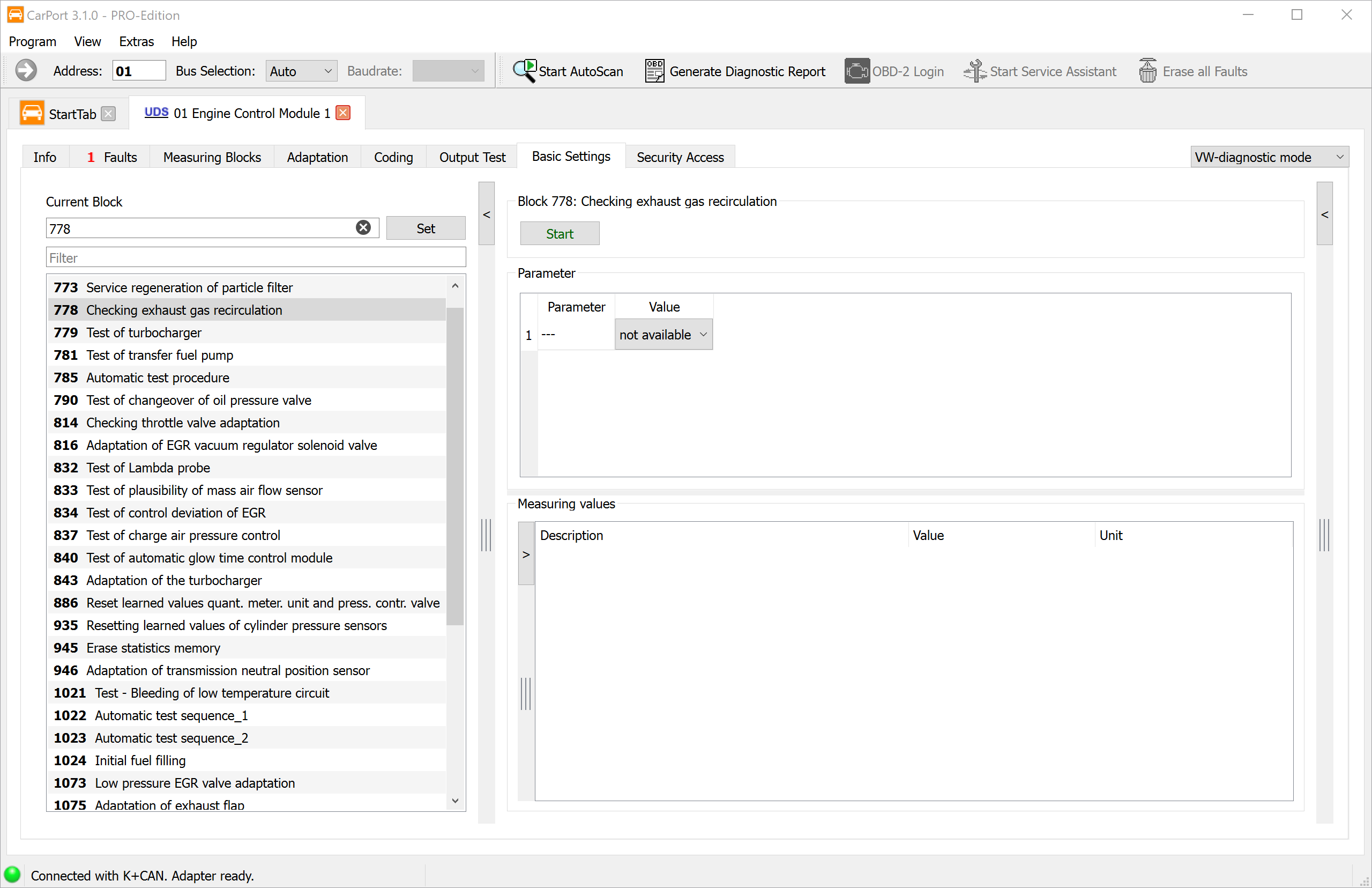
| Block | Basic setting | Purpose |
|---|---|---|
| 778 | Checking exhaust gas recirculation | Active function test of the EGR path |
| 816 | Adaptation of EGR vacuum regulator solenoid valve | Relearns the end stops of the EGR valve |
| 834 | Test of control deviation of EGR | Checks whether the target and actual EGR rate match |
| 1073 | Low pressure EGR valve adaptation | Relearns the end stops of the LP-EGR valve |
| 1075 | Adaptation of exhaust flap | Relearns the end stops of the exhaust flap |
| 1076 | Low-pressure EGR differential pressure sensor adaptation | Re-references the zero point of the LP-EGR differential pressure sensor |
| 1088 | Manual test of low pressure EGR valve | User-controlled actuation for a mobility check |
| 1089 | Manual test of exhaust flat | User-controlled actuation of the exhaust flap |
| 1245 | Automatic check of low pressure EGR filter | Control-unit-controlled check of the LP-EGR filter |
Test vs. adaptation vs. manual test: A test only determines whether a component works (result passed/not passed) without permanently changing learned values. An adaptation, on the other hand, deliberately changes the learned values of the control unit (e.g. end stops after a replacement). A manual test leaves the actuation to you, so that you can observe the movement yourself.
🔧 Rule of thumb for engine state – engine running or not?
- Tests (blocks 778, 834, 1245) run with the engine running and at operating temperature at idle. The control unit actively actuates the valve and measures the response (e.g. the air mass) – this requires a real exhaust or air flow. During the test the EGR valve is opened and closed alternately; the air mass must respond measurably.
- Adaptations (blocks 816, 1073, 1075, 1076) and the manual tests (blocks 1088, 1089) run with ignition on and engine off. End stops or the sensor zero point are relearned without an exhaust flow, the actuator moved and observed without combustion. Ensure a stable vehicle electrical system voltage (guide value approx. 12.5 V).
⚠️ Do not confuse: Block
1076“Low-pressure EGR differential pressure sensor adaptation” applies to the sensor of the low-pressure EGR path – not the DPF differential pressure sensor. A different block is responsible for work on the particulate filter.
3. Prerequisites
- The diagnostic interface is connected (the status bar at the bottom shows e.g. “Connected with … Adapter ready.”)
- Control unit 01 – Engine Control Module 1 is open, tab Basic Settings
- The triggering work is complete (valve/cooler cleaned or replaced, connectors and hoses seated and sealed)
- Engine state depending on the routine (see rule of thumb in section 2): active tests with the engine running and at operating temperature at idle, adaptations and manual tests with ignition on, engine off. The control unit dictates the condition and aborts if it is not met
- Stable vehicle electrical system voltage (connect a charger if needed)
- Read out the engine control unit’s fault memory beforehand and clear it once the cause has been fixed
4. Checking exhaust gas recirculation
The Checking exhaust gas recirculation routine (block 778) is an active function test, not a relearning procedure. It runs with the engine running and at operating temperature at idle – only then is there a real exhaust and air flow whose response can be measured. After clicking Start, the control unit deliberately actuates the EGR valve – opening and closing it – and observes the response of the remaining sensors, above all the air mass (mass air flow sensor):
- When the valve opens, recirculated exhaust gas flows into the intake tract and displaces fresh air – the measured air mass must drop measurably.
- When the valve closes again, the air mass rises back up.
If the air mass responds as expected, the EGR path is considered functional. If the response is absent or too small, this points to a seized, coked or leaking valve, blocked passages or a defective actuator. The control unit reports the result as passed / not passed; learned values are not permanently changed in the process.
Additionally, block 834 “Test of control deviation of EGR” checks whether the actually recirculated quantity matches the quantity requested by the control unit – too large a deviation is the classic trigger for the fault “control deviation exhaust gas recirculation”.
5. Adaptation of EGR vacuum regulator solenoid valve
The Adaptation of EGR vacuum regulator solenoid valve (block 816) is a relearning procedure and runs with ignition on and engine off (stable vehicle electrical system voltage, guide value approx. 12.5 V): the control unit moves the EGR valve to its mechanical end stops (fully closed and fully open) and stores the corresponding position values of the position sender as new learned values. Because no response of the exhaust flow is measured here, the engine may – and should – be stationary.
This way, the control loop again knows exactly which actuation value corresponds to which real valve position. The adaptation is needed above all:
- after replacing the EGR valve,
- after cleaning the valve (changed friction/end stop due to removed deposits),
- when a fault points to an implausible valve position or a missing basic setting.
Without this adaptation, the control unit calculates with the old position values – control becomes inaccurate, the EGR rate is no longer correct, and renewed control deviation faults are likely. Unlike the test in step 4, the adaptation permanently changes the stored learned values.
For the low-pressure path there are corresponding adaptations as separate blocks: 1073 (LP-EGR valve), 1075 (exhaust flap) and 1076 (differential pressure sensor).
6. Manual test of low pressure EGR valve
The Manual test of low pressure EGR valve (block 1088) lets you actuate the LP-EGR valve instead of leaving the procedure to the control unit alone. It runs with ignition on and engine off, so that the actuator can be run through and observed safely without an exhaust flow. You specify a position (open/close or step by step) and observe the position feedback and the movement of the valve.
The purpose is the mechanical mobility check: the low-pressure EGR valve sits in the exhaust flow downstream of the DPF and can become stiff or seize due to soot deposits. In the manual test you can identify
- whether the valve follows the actuation command cleanly and completely,
- whether it sticks, jams or reacts with a delay at some point,
- whether the position feedback matches the commanded position.
This makes it possible to assess specifically whether the valve is still fine, needs cleaning or must be replaced – before running an adaptation or replacing a component unnecessarily. For the exhaust flap there is the same manual test with block 1089; 1245, in contrast, checks the LP-EGR filter automatically (control-unit-controlled).
7. Check the result
- Clear the fault memory and read it out again – no new EGR fault (control deviation, valve position, differential pressure) may be stored.
- In the Measuring Blocks, check the EGR-relevant values for plausibility, e.g. target and actual EGR rate, air mass and valve position. With the valve closed, the air mass should correspond to the fresh-air demand.
- Take a short test drive – ideally with diagnostics connected – across various load points and verify that the EGR controls cleanly and that no fault recurs.
8. Pitfalls and notes
- Fix the cause first: Adaptation and test require a mechanically intact component. A coked, seized valve is not freed up by relearning – clean/replace first, then adapt.
- Choose the correct path: High-pressure and low-pressure EGR have separate valves and blocks. First check which path is affected and choose the matching block (778/816 for HP, 1073/1075/1076/1088/1089/1245 for LP).
- Mind the order: The sensible sequence is usually manual test/check → clean or replace → adapt → check again. An adaptation before the repair only learns in the bad state.
- Conditions come from the control unit: Which values are displayed and which prerequisites (engine off/on, temperature, voltage) apply is dictated by the control unit; if the conditions are not met, the routine will not run.
- Do not confuse the differential pressure sensor: The LP-EGR differential
pressure sensor (block
1076) is not the DPF differential pressure sensor – pay attention to the correct path and part number. - Missing blocks: Depending on the engine, software level and coding, not all blocks are visible or they are named slightly differently – this is normal and not a fault. If the engine has no low-pressure EGR, the associated blocks are missing entirely.